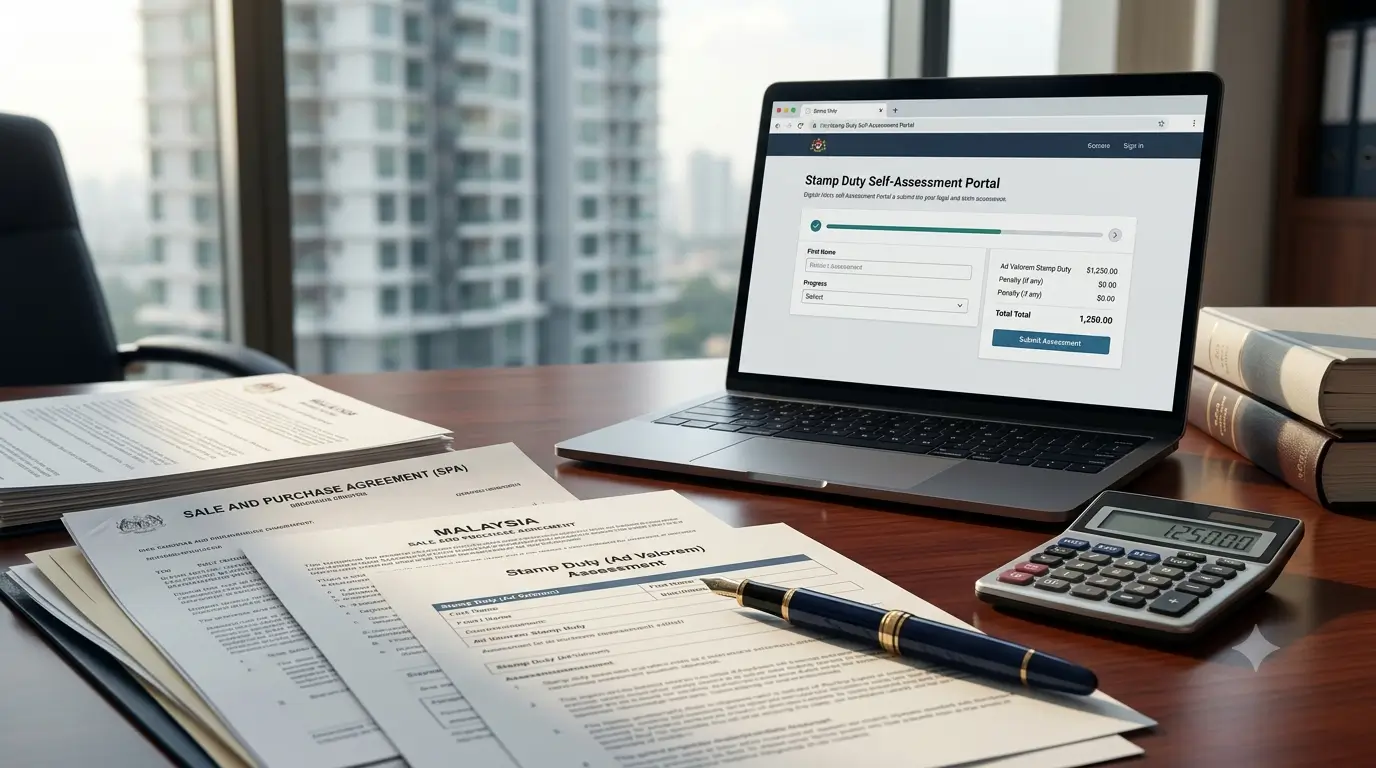
Navigating SDSAS: What Buyers and Sellers Should Know About Stamp Duty

Malaysian property transaction and stamp duty self-assessment system

By Mohd Fadzrin Md Safea.

If you’ve bought or sold property in Malaysia before, you probably never thought much about how stamp duty was actually calculated. You’d sign the Sale and Purchase Agreement, your lawyer would sort out the paperwork, and at some point LHDN would tell everyone what was owed. An officer at the Collector’s office checked the sums before you paid a single ringgit. Nobody had to worry about whether the number was right. That was LHDN’s job.

That backstop is now being removed. Starting 1 January 2026, LHDN began phasing in the Stamp Duty Self-Assessment System, or SDSAS, and it changes something fundamental: the responsibility for getting the calculation right now sits with you, the taxpayer, not with LHDN. If you’re planning to buy, sell, or finance a property in the next year or two, this is worth understanding before you sign anything.

What’s actually changing

Under the old system, stamping was something LHDN did for you. You’d lodge the Sale and Purchase Agreement, the Memorandum of Transfer, the loan documents, and LHDN would work out the market value (calling in a government valuer if needed), calculate the duty, and issue a formal assessment. Only then would the document get stamped. That whole process ran through a portal called STAMPS, which was shut down for good at the end of 2025.

SDSAS reverses that sequence. Now, you, or in practice, your lawyer, acting on your behalf, will work out the duty yourselves, file a return through a new system called e-Duti Setem on the MyTax portal, and pay within 30 days. The moment that’s done, it’s treated as final. Nobody at LHDN checks the maths before your money changes hands.

That doesn’t mean LHDN has stopped checking altogether, it’s just moved the checking to after the fact. You (or your lawyer, acting as your agent) are required to keep the stamped instrument and all related records for seven years, and audits of recent transactions are already underway. So the risk hasn’t disappeared. It’s just been pushed further down the road, to a point where it’s harder and more expensive to fix.

The rollout is happening in stages, and property is not among the first

SDSAS isn’t switching on for every document at once, and the timing matters if you’re mid-transaction:

  • From 1 January 2026 — tenancy agreements, general commercial contracts, and loan securities moved to self-assessment.
  • From 1 January 2027 — property transfer documents come into scope, but only where the transfer doesn’t require a valuation from the government valuer (JPPH). This covers most straightforward Memorandum of Transfer (Form 14A) and Deed of Assignment cases.
  • From 1 January 2028 — everything else follows, which includes property transfers that do require a JPPH valuation.

A lot of people assume that because tenancy agreements are already self-assessed, their Sale and Purchase Agreement or transfer document must be too. It isn’t, not yet. If you’re buying or selling property today, the current process still applies to the property transfer itself, right up until Phase 2 takes effect in January 2027 — and even then, whether your specific transaction falls under Phase 2 or waits until Phase 3 in 2028 depends on whether a JPPH valuation is required. That’s usually triggered by things like a below-market declared price, a related-party transfer, or a valuation dispute — so it’s worth asking your lawyer early whether your transaction is likely to need one. Deals that start before the relevant switch-over date and complete after it will need to be handled carefully, since the rules aren’t the same on either side.

There is one piece of good news: LHDN has said it won’t penalise honest mistakes made during 2026, the first year of the new system. That’s a genuine concession, but don’t treat it as a safety net. “Honest mistake” doesn’t cover carelessness, and it won’t apply once the transitional period ends.

On top of the systems change, Budget 2026 also changed the rates themselves. If you’re a foreign buyer, stamp duty on residential property is now a flat 8%, double the previous 4% rate. If you’re a Malaysian citizen buying your first home, the exemption threshold has been revised to cover properties priced at RM500,000 or below, for agreements signed between 1 January 2026 and 31 December 2027. Either of these could materially change what you end up paying, so it’s worth confirming exactly where you stand before you commit to a price.

What this looks like in practice

Say you’re a Malaysian citizen buying a sub-sale condominium for RM1,000,000, with part of the price financed by a bank loan. Once Phase 2 takes effect, the stamp duty on the transfer — worked out at tiered rates of 1% to 4% depending on the value band, plus 0.5% on the loan amount — will be calculated and paid without LHDN checking it beforehand. If that calculation is wrong — the wrong rate applied, or an exemption missed or wrongly claimed — that error sits in your file until an audit eventually catches it, by which point interest may already have accrued.

Now imagine you’re a foreign purchaser in the same scenario. At 8% flat, stamp duty on a RM1,000,000 property comes to RM80,000, compared to roughly RM44,000 for a citizen buyer under the tiered rates. That’s not a small difference to get wrong, and under the old system, LHDN’s own check would have flagged an incorrect rate before your purchase completed. That check no longer exists.

What does this mean for you, practically? A few things worth knowing before you get deep into a transaction:

  • You’ll need a MyTax account and Tax Identification Number (TIN) in place before stamping can happen — worth sorting out early rather than at the last minute.
  • Ask for a written stamp duty computation, not a rough verbal estimate, so you know exactly what you’re paying and why.
  • If you’re selling, pay attention to how the stamp duty clause in your SPA is worded — who’s responsible for the duty, and whether there’s an indemnity attached, matters more now than it used to.
  • If you’re financing the purchase, your bank’s solicitors should be able to show their calculation is solid, not just confirm that duty has been paid.

Where things commonly go wrong

A few problem areas are already turning up, and it’s worth knowing what they are so you can ask the right questions.

Getting the type of document wrong, treating something as a Deed of Assignment when it should really be a Memorandum of Transfer for instance, used to get picked up and corrected at the assessment stage. Now, it might go unnoticed until an audit years later. The same goes for disputes over property value: if LHDN later disagrees with the declared price, you’re the one who has to justify it, rather than relying on a government valuation obtained upfront.

Deadlines matter more too. Miss the 30-day payment window and penalties start at RM50 or 10% of the shortfall, rising to RM100 or 20% after three months. Fail to file the return at all, and there’s a separate penalty for that.

And because LHDN is already auditing instruments stamped over the past few years, this isn’t purely a future risk. Older transactions can be reopened too, particularly where the valuation or classification was borderline at the time.

What you should do about it

None of this means buying or selling property has become more complicated in principle. The sequence of signing, stamping, obtaining consent, and registering the title hasn’t changed. What’s changed is that the stamp duty figure now deserves as much scrutiny as any other part of the deal, rather than being something you can assume LHDN will catch if it’s wrong.

Before you sign anything, it’s worth asking your lawyer a few direct questions: Which phase of SDSAS applies to your transaction, and when? Does your transaction need a JPPH valuation, and if so, does that push you into a later phase than you expected? What’s the actual duty computation, in writing, and what’s it based on? If you’re a foreign buyer or a first-time buyer, have the current rates and exemptions been checked against the latest rules, not last year’s? And if your deal is likely to straddle a phase switchover, has that been accounted for?

The bottom line

If you’re planning to buy, sell, or finance a property in the next year or two, the date to keep in mind is 1 January 2027, when most property transfer documents move under self-assessment — though transactions requiring a JPPH valuation get a longer runway, moving over only in 2028. Until your transaction’s applicable date arrives, the safest approach is to work with a lawyer who is already treating the stamp duty calculation as something that needs to be right the first time, not paperwork that LHDN will quietly fix for you.

If you’d like to understand exactly how this affects a purchase, sale, or financing arrangement you’re considering, we’re happy to talk it through.


This article is provided for general informational purposes only. It is not intended to, and should not be construed as, legal advice. The discussion herein is meant to highlight key considerations in a broad sense, and may not reflect the full scope of issues relevant to your particular situation. Readers are encouraged to treat this content as background knowledge rather than a substitute for professional counsel. For guidance tailored to your specific circumstances, please contact our firm directly. We would be pleased to provide advice that takes into account the details of your transaction and objectives. 

Share this insight

© 1978 - Nik Saghir & Ismail Advocates & Solicitors. All rights reserved.

Book an Appointment

Privacy Policy

PERSONAL DATA PROTECTION NOTICE

This Personal Data Protection Notice (“Notice”) sets out how Messrs. NIK SAGHIR & ISMAIL (“Firm”) collects, uses and protects your Personal Data which you have provided to the Firm. By engaging the Firm to provide its services or by accessing the Firm’s website at www.nsi.com.my (“Website”), you hereby consent to the processing of your Personal Data by the Firm in the provision of legal and secretarial or any other services that you have requested from the Firm (“Services”).

1. PERSONAL DATA

1.1 The “Personal Data” that you provide or have provided to the Firm includes your name, contact details, address, telephone numbers, email address, NRIC number or passport number, bank account information, income tax reference number, etc.

1.2 In addition to the Personal Data that you provide to the Firm directly (whether when engaging us to provide our services or during any communication with the Firm), the Firm may also collect your Personal Data from various other sources, including without limitation, from online search tools, information obtained from third parties through lawful sources including but not limited to Companies Commission of Malaysia, National Registration Department of Malaysia, or at events organised or participated by the Firm.

1.3 In respect of personal data of third parties such as your spouse and family members, you warrant that you have obtained their consent allowing us to process their personal data and you will extend a copy of this Notice to them.

2. PURPOSE OF PROCESSING OF PERSONAL DATA

2.1 By engaging the Firm, you hereby agree and consent to the Firm using and processing your Personal Data provided to the Firm, in the manner and for the purposes as described below:

(1) for the purposes of the Services;

(2) for preparing any document or instrument which may be required for the purposes set out in sub-paragraph (1) above and such other ancillary work in connection with sub-paragraph (1) above, including but not limited to, preparing the necessary contract or agreement or instrument to which you are a party, preparing loan agreement and preparing affidavits;

(3) to provide such necessary information to any regulatory or governmental authorities as required by statutory, regulatory or governmental requirements;

(4) for the Firm’s internal administrative purposes including historical and conflict checking purposes;

(5) for the Firm to communicate with you; and

(6) for the Firm to comply with its obligations under law or any regulations imposed by regulatory or governmental authorities.

2.2 It is voluntary for you to supply your Personal Data to the Firm. However, if you do not wish to provide your Personal Data, the Firm may not be able to:

(1) provide you the services that you require; or

(2) communicate effectively with you.

2.3 The Firm may also use and process your Personal Data for other purposes such as:

(1) to send you materials such as season greeting cards, newsletters, articles, write-ups and other updates, distribute information of events, conferences, talks and seminars which may be of interest to you; and

(2) potential referees to editors / researchers in legal ranking publications and journals and potential clients who request for referees of past work in our credential statements, tenders and submissions,

if any, by way of email or mail.

If you do not agree or consent to the Firm processing your Personal Data for the purposes set out in this paragraph 2.3, please notify the Firm by contacting the Firm via the contact details set out in paragraph 6.1 below.

3. DISCLOSURE OF PERSONAL DATA

3.1 Your Personal Data provided to the Firm or obtained by the Firm shall be kept confidential by the Firm. However, it may be necessary for the Firm to engage third party companies, service providers or individuals to perform certain services on the Firm’s behalf. In such event, you hereby agree and consent that the Firm may disclose and transfer your Personal Data to the third parties, within or outside Malaysia, including without limitation, as follows:

(1) banks and financial institutions;
(2) insurance providers;
(3) storage facility providers;
(4) external advisors and other professional advisors, such as auditors; and
(5) such other party as the Firm deems necessary for the purposes mentioned in paragraph 2 above.

3.2 The Firm shall also disclose and transfer the information to any statutory bodies, regulatory bodies and / or governmental authorities where legally required to do so.

4. EMAIL AND WEBSITE

4.1 Any Personal Data contained in the emails and “Contact Us” messages sent via the Firm’s Website to the Firm shall be used and processed in the manner set out in this Notice. The content of the messages shall be strictly monitored by the Firm.

4.2 If you do not wish for your Personal Data to be collected via cookies on the Website, please configure your internet browser to delete or deactivate cookies.

4.3 The Firm’s Website may contain links to other sites and pages. The Firm shall not be responsible for any Personal Data or information that you may provide to other entity via the links.

5. REQUEST FOR ACCESS AND INQUIRIES

5.1 You may at any time hereafter request for access to, or request for rectification or correction of your Personal Data (subject to payment of fees, if applicable), or limit the processing of your Personal Data by the Firm, as the case may be, however subject to the exceptions and restrictions as may be contained under the applicable law. If you wish to do so, please contact:

Managing Partner
Tel: 03-4043-2888
Fax: 03-4043-8800

You may also contact the Firm via the above contact details if you have any inquiries or complaints in respect of your Personal Data provided to the Firm.

5.2 Please note that the Firm has the right to refuse your request to access and / or make any correction to your Personal Data to the extent permitted under the applicable law.

6. GENERAL

6.1 The Firm reserves the right to amend or modify this Notice from time to time.

Disclaimer

The information contained in this website is for general information purposes only. Such information is not intended to replace legal advice nor is a substitute for specific advice concerning individual situations. While we endeavour to keep the information up to date and correct, we make no representations or warranties of any kind, express or implied, about the completeness, accuracy, reliability, suitability or availability with respect to the website or the information on the website for any purpose. Any reliance you place on such information is therefore strictly at your own risk.

Every effort has been made to ensure that the information displayed on the website is accurate as at the date of issue. Changes in law or circumstances may occur after the issue date, which may make information displayed no longer accurate or may not reflect the current legal position.

We shall not be responsible for any loss or damage arising from your reliance on any information provided on this website. Should you require specific legal advice, please do not hesitate to contact us.

Through this website you may be able to link to other websites which are not under our control. We have no control over the nature, content and availability of those sites. The inclusion of any links does not necessarily imply a recommendation or endorse the views expressed within them.