
By Mohd Fadzrin Md Safea.
If you’ve bought or sold property in Malaysia before, you probably never thought much about how stamp duty was actually calculated. You’d sign the Sale and Purchase Agreement, your lawyer would sort out the paperwork, and at some point LHDN would tell everyone what was owed. An officer at the Collector’s office checked the sums before you paid a single ringgit. Nobody had to worry about whether the number was right. That was LHDN’s job.
That backstop is now being removed. Starting 1 January 2026, LHDN began phasing in the Stamp Duty Self-Assessment System, or SDSAS, and it changes something fundamental: the responsibility for getting the calculation right now sits with you, the taxpayer, not with LHDN. If you’re planning to buy, sell, or finance a property in the next year or two, this is worth understanding before you sign anything.
Under the old system, stamping was something LHDN did for you. You’d lodge the Sale and Purchase Agreement, the Memorandum of Transfer, the loan documents, and LHDN would work out the market value (calling in a government valuer if needed), calculate the duty, and issue a formal assessment. Only then would the document get stamped. That whole process ran through a portal called STAMPS, which was shut down for good at the end of 2025.
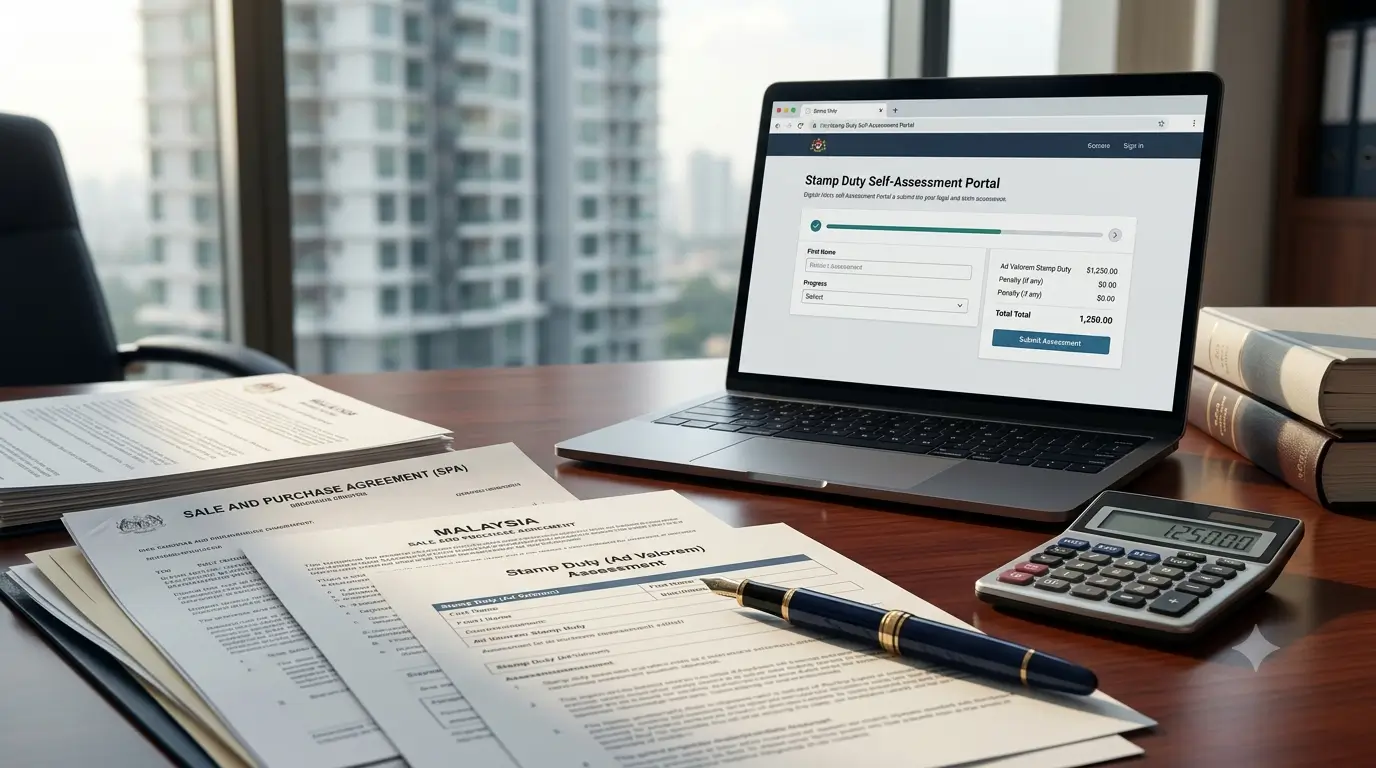
SDSAS reverses that sequence. Now, you, or in practice, your lawyer, acting on your behalf, will work out the duty yourselves, file a return through a new system called e-Duti Setem on the MyTax portal, and pay within 30 days. The moment that’s done, it’s treated as final. Nobody at LHDN checks the maths before your money changes hands.
That doesn’t mean LHDN has stopped checking altogether, it’s just moved the checking to after the fact. You (or your lawyer, acting as your agent) are required to keep the stamped instrument and all related records for seven years, and audits of recent transactions are already underway. So the risk hasn’t disappeared. It’s just been pushed further down the road, to a point where it’s harder and more expensive to fix.
SDSAS isn’t switching on for every document at once, and the timing matters if you’re mid-transaction:
A lot of people assume that because tenancy agreements are already self-assessed, their Sale and Purchase Agreement or transfer document must be too. It isn’t, not yet. If you’re buying or selling property today, the current process still applies to the property transfer itself, right up until Phase 2 takes effect in January 2027 — and even then, whether your specific transaction falls under Phase 2 or waits until Phase 3 in 2028 depends on whether a JPPH valuation is required. That’s usually triggered by things like a below-market declared price, a related-party transfer, or a valuation dispute — so it’s worth asking your lawyer early whether your transaction is likely to need one. Deals that start before the relevant switch-over date and complete after it will need to be handled carefully, since the rules aren’t the same on either side.
There is one piece of good news: LHDN has said it won’t penalise honest mistakes made during 2026, the first year of the new system. That’s a genuine concession, but don’t treat it as a safety net. “Honest mistake” doesn’t cover carelessness, and it won’t apply once the transitional period ends.
On top of the systems change, Budget 2026 also changed the rates themselves. If you’re a foreign buyer, stamp duty on residential property is now a flat 8%, double the previous 4% rate. If you’re a Malaysian citizen buying your first home, the exemption threshold has been revised to cover properties priced at RM500,000 or below, for agreements signed between 1 January 2026 and 31 December 2027. Either of these could materially change what you end up paying, so it’s worth confirming exactly where you stand before you commit to a price.
Say you’re a Malaysian citizen buying a sub-sale condominium for RM1,000,000, with part of the price financed by a bank loan. Once Phase 2 takes effect, the stamp duty on the transfer — worked out at tiered rates of 1% to 4% depending on the value band, plus 0.5% on the loan amount — will be calculated and paid without LHDN checking it beforehand. If that calculation is wrong — the wrong rate applied, or an exemption missed or wrongly claimed — that error sits in your file until an audit eventually catches it, by which point interest may already have accrued.
Now imagine you’re a foreign purchaser in the same scenario. At 8% flat, stamp duty on a RM1,000,000 property comes to RM80,000, compared to roughly RM44,000 for a citizen buyer under the tiered rates. That’s not a small difference to get wrong, and under the old system, LHDN’s own check would have flagged an incorrect rate before your purchase completed. That check no longer exists.
What does this mean for you, practically? A few things worth knowing before you get deep into a transaction:
A few problem areas are already turning up, and it’s worth knowing what they are so you can ask the right questions.
Getting the type of document wrong, treating something as a Deed of Assignment when it should really be a Memorandum of Transfer for instance, used to get picked up and corrected at the assessment stage. Now, it might go unnoticed until an audit years later. The same goes for disputes over property value: if LHDN later disagrees with the declared price, you’re the one who has to justify it, rather than relying on a government valuation obtained upfront.
Deadlines matter more too. Miss the 30-day payment window and penalties start at RM50 or 10% of the shortfall, rising to RM100 or 20% after three months. Fail to file the return at all, and there’s a separate penalty for that.
And because LHDN is already auditing instruments stamped over the past few years, this isn’t purely a future risk. Older transactions can be reopened too, particularly where the valuation or classification was borderline at the time.
None of this means buying or selling property has become more complicated in principle. The sequence of signing, stamping, obtaining consent, and registering the title hasn’t changed. What’s changed is that the stamp duty figure now deserves as much scrutiny as any other part of the deal, rather than being something you can assume LHDN will catch if it’s wrong.
Before you sign anything, it’s worth asking your lawyer a few direct questions: Which phase of SDSAS applies to your transaction, and when? Does your transaction need a JPPH valuation, and if so, does that push you into a later phase than you expected? What’s the actual duty computation, in writing, and what’s it based on? If you’re a foreign buyer or a first-time buyer, have the current rates and exemptions been checked against the latest rules, not last year’s? And if your deal is likely to straddle a phase switchover, has that been accounted for?
If you’re planning to buy, sell, or finance a property in the next year or two, the date to keep in mind is 1 January 2027, when most property transfer documents move under self-assessment — though transactions requiring a JPPH valuation get a longer runway, moving over only in 2028. Until your transaction’s applicable date arrives, the safest approach is to work with a lawyer who is already treating the stamp duty calculation as something that needs to be right the first time, not paperwork that LHDN will quietly fix for you.
If you’d like to understand exactly how this affects a purchase, sale, or financing arrangement you’re considering, we’re happy to talk it through.
This article is provided for general informational purposes only. It is not intended to, and should not be construed as, legal advice. The discussion herein is meant to highlight key considerations in a broad sense, and may not reflect the full scope of issues relevant to your particular situation. Readers are encouraged to treat this content as background knowledge rather than a substitute for professional counsel. For guidance tailored to your specific circumstances, please contact our firm directly. We would be pleased to provide advice that takes into account the details of your transaction and objectives.